Sunday, 1 November 2009

Praying to Dead Saints or love one

Print Friendly and PDF

Do you know where you stand on the subject of speaking to the dead?

"Some 'Christian' denominations teach that you can pray to your loved ones or to saints who have died and that they will hear you. Hmm, do they really? You may argue that you do not pray to them but talk to them only, so what is wrong with that?

A young man with a deep problem went to consult a pastor for support and guidance. Unsatisfied with the result, he left to visit his father's grave and spoke to him. A few days later, his problem was resolved, and everything turned out well. On all saint days, in his message, the pasture explained that there was nothing wrong with that. But what does the bible have to say about speaking to the dead loved one?

This usually happens when someone teaches the tradition of man instead of the doctrine of God. "Beware lest anyone cheat you through philosophy and empty deceit, according to the tradition of men, according to the basic principles of the world, and not according to Christ," Colossians 2:8.

Deuteronomy 18:10-11 teaches us to avoid the medium and consult the dead. "There shall not be found among you anyone who makes his son or his daughter pass through the fire, or one who practices witchcraft, or a soothsayer, or one who interprets omens, or a sorcerer, or one who conjures spells, or a medium, or a spiritism, or one who calls up the dead."

Now, you may retort by saying that this young man was not consulting a medium that he was talking to his deceased dad and that it only shows how much he misses his dad. You would tell me, "What right do I have to judge him, and that I should not leave him alone?" It is his grief and his problem.

Have you ever experienced talking to a friend on a cell phone only to find out that the signal was cut off, and you only noticed it a few minutes later? All that time, you were talking to nobody. This is what happens when you talk to the dead; no one is listening. That is explained in Ecclesiastes 9:5: "For the living know that they will die, But the dead know nothing, And they have no more reward, For the memory of them is forgotten."


What proof do I have that the dead cannot help or communicate with us? If you are not a Christian, outside of the word of God, I have no proof to argue the contrary, but I have a few arguments for a Christian who talks to decease.

What would be the purpose of a Christ resurrection? So, Christian did ask that question in 1 Corinthians 15:12: "Now if Christ is preached that He has been raised from the dead, how do some among you say that there is no resurrection of the dead?" Please read the following commentary titled "The Resurrection Gospel."

There is a resurrection, and this is the sequence of how it will happen. 1 Thessalonians 4:16-17 "For the Lord Himself will descend from heaven with a shout, with the voice of an archangel, and with the trumpet of God.  And the dead in Christ will rise first.  Then we who are alive and remain shall be caught up together with them in the clouds to meet the Lord in the air. And thus we shall always be with the Lord."


Source

You may argue that while they await the resurrection, nothing stops them from helping their close one who is still alive, and you may argue that the dead saint intervenes on our behalf; after all, they are closer to God than us. By saying this, you are showing your doubt about the presence of Jesus in your life. He is never too busy and tired to listen to and help you. Jesus continually invites us to rest in Him. It pleases Him that you trust Him and that you wait for Him.

Being saved by believing in Jesus does give us eternal life, yet the dead who are waiting for the resurrection have no power and no authority to help anyone.


Matthew 28:18 And Jesus came and spoke to them, saying, "All authority has been given to Me in heaven and on earth."  As Christians, are we not called to trust in Him for all our needs?   We are invited to be in fellowship with Him and the Father. That is the reason Jesus died for us: to close the gap ( caused by sin) that was separating us.

Jesus instructs us to avoid those who intervene on our behalf and those who encourage doing so. Leviticus 19:31: "Give no regard to mediums and familiar spirits; do not seek after them, to be defiled by them: I am the LORD your God." God considers adultery those who talk to the dead." Leviticus 20:6  "And the person who turns to mediums and familiar spirits, to prostitute himself with them, I will set My face against that person and cut him off from his people."
Source
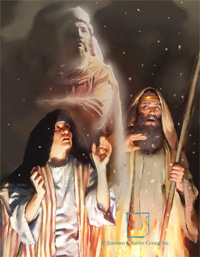
Jesus does not want you to be deceived by the false spirit as Saul has been.  Saul sought advice for a coming battle against his enemies. 1 Samuel 28:7  "Then Saul said to his servants, find me a woman who is a medium, that I may go to her and inquire of her.  And his servants said to him, in fact, there is a woman who is a medium at En Dor."

Now again, you will argue that this young man who spoke to his deceased father got his prayer answered since his entire problem went away.  That is proof that his dad heard him. This is the greatest deception. He was drawn away from God instead of being drawn closer to God.  Satan causes this deception. That is Satan's device. He wants to make a man turn away from God. Isaiah 8:19  "And when they say to you, "Seek those who are mediums and wizards, who whisper and mutter," should not a people seek their God? Should they seek the dead on behalf of the living?"

This man first sought advice from his pastor, and since the answer of his pastor was unsatisfactory, he went to his deceased father's grave. Satan accomplishes his goal by taking away the problem that he had caused in the first place. This man is not any closer to God and to salvation.

Jesus describes Satan in this manner: John 8:44: "You are of your father the devil, and the desires of your father you want to do. He was a murderer from the beginning and does not stand in the truth, because there is no truth in him. When he speaks a lie, he speaks from his own resources, for he is a liar and the father of it."  Revelation 12:9: "So the great dragon was cast out, that serpent of old, called the Devil and Satan, who deceives the whole world; he was cast to the earth, and his angels were cast out with him."

Do not talk to the dead, even the loved ones that you miss. Tell the Father in Heaven that you miss them. Follow the real example of all the saints who were waiting for our blessed hope, the rapture; they trusted Jesus and prayed to the Father only. By the way, whoever believes in the One that God had sent is also considered a saint. God justified you.  He makes you righteous in His presence; you are, therefore, a saint.

Make the right choice. 

"And the person who turns to mediums and familiar spirits, to prostitute himself with them, I will set My face against that person and cut him off from his people,"
Leviticus 20:6

But instead, 

Let us therefore come boldly to the throne of grace, that we may obtain mercy and find grace to help in time of need," Hebrews 4:16.


I used to believe that the dead were not going to heaven and were waiting for the resurrection when Jesus returned for them and for the Church at an event called the rapture. Not anymore.  The soul goes to heaven and then waits for the event called the rapture. This video explains how that's possible. 

Where Did Jesus Go for Three Days and Three Nights after He was Crucified - by Hank Lindstrom


Monday, 26 October 2009

Time to make one Decision

Print Friendly and PDF
Decision


Be anxious for nothing, but in everything by prayer and supplication, with thanksgiving, let your requests be made known to God; and the peace of God, which surpasses all understanding, will guard your hearts and minds through Christ Jesus.Philippians 4:6–7


The just shall live by faith. Romans 1:17


There is a time in life when we get tired of trying to live by faith. It takes effort to put our best foot forward…to act as we believe. Yet, it torments me not being able to please God by just trusting Him. Read PS 78. It shows the example of Israel's lack of faith in the One that kept on showing His presence by all sorts of miracles and interventions.

I want to please my Lord, My God, and make Him happy by trusting Him


I trust Him and that is my decision. Make it yours also.

Friday, 18 September 2009

Christ Return Very Soon

Print Friendly and PDF
The undisputed return of Jesus is the next prophetic advent…..soon as IMMINENT!

As we understand the law of physics and we would see a heavy mass hanging by a fine thread over our head, we would conclude that the mass is ready to fall at any moment.  When we see a heavy mass hanging by a steel cable, we conclude that it would take some time before it falls. It will take some changes in the mass or in the wear of the cable before we can conclude that it will fall at any time.

If we know, how to discern the sign of time we can, therefore, predict the soon return of Jesus, not His return but the state of its imminency, or condition nearby pertaining to the event of His return. The study of bible prophecy should be considered a science of discerning the sign of His instant return and not the time of His return.

Many students of bible prophecy including myself concluded that we are living in the immediate return of Our Lord. The establishment of the nation of Israel in 1948 seems to be the final event before His return predicted in Ezekiel (which is the rapture for the church and judgement to all nations).  His return is hanging by a thread.


Imminency and the Any-Moment Rapture 
By Dr. Thomas Ice - www.pre-trib.org

We believe that our Lord and Savior Jesus Christ could come in the clouds at any moment and take His church to be with Him to His Father's house (John 14:1-3). What a great hope, that while you are reading this article, our Lord could return and rapture His church. We have come to call this any-moment hope of the rapture an imminent event.
The English word "imminent" (of Latin derivation) can be used in many ways, it is used to note the New Testament teaching that Christ could return and rapture His church at any moment, without prior signs or warning. Use of the term "imminency" entered the lexicon of American Evangelicalism around the end of the last century in contrast to the dominant, but waning, postmillennialism which taught that Christ's coming was not imminent. Postmillennialism held that Christ's return must first await the Christianization of the world by the Church. By the 1930s, it was common to pack into one theological expression - imminency - all of the many New Testament ways in which Christ's coming for His Church is said to be possible at any moment. Thus, imminency and the any-moment return of Christ became synonyms for the pretribulation rapture of the church.
In fact, imminency is such a powerful argument for pretribulationism that it is one of the most frequent and fiercely attacked doctrines by our opponents. Non-pretribulationists sense that if the New Testament teaches imminency, then pretribulationism is virtually assured.

Definition of Imminency

What is the biblical definition of imminency? Four important elements contribute to a pretribulation understanding of imminency. 

First, imminency means that the rapture could take place at any moment. While other events may take place before the rapture, no event must precede it. If prior events are required before the rapture, then the rapture could not be described as imminent. Thus, if any event were required to occur before the rapture, then the concept of imminency would be destroyed.


Second, since the rapture is imminent and could happen at any moment, then it follows that one must be prepared for it to occur at any time, without sign or warning.

Third, imminency eliminates any attempt at date setting. Date setting is impossible since the rapture is signless (i.e., providing no basis for date setting) and if imminency is really true, the moment a date was fixed then Christ could not come at any moment, destroying imminency. Fourth, Renald Showers says, "A person cannot legitimately say that an imminent event will happen soon. The term 'soon' implies that an event must take place 'within a short time (after a particular point of time specified or implied).' By contrast, an imminent event may take place within a short time, but it does not have to do so in order to be imminent. As I hope you can see by now, "imminent" is not equal to 'soon.'" [1] A. T. Pierson has noted that "Imminence is the combination of two conditions, viz.,: certainty and uncertainty. By an imminent event, we mean one which is certain to occur at some time, uncertain at what time." [2]

Imminency in the New Testament

The fact that Christ could return, but may not soon, at any moment, yet without the necessity of signs preceding His return, requires the kind of imminence taught by pretribulationism.

What New Testament passages teach this truth? Those verses stated that Christ could return at any moment, without warning and instructing believers to wait and look for the Lord's coming to teach the doctrine of imminence. Note the following New Testament passages:

  • 1 Corinthians 1:7 - "awaiting eagerly the revelation of our Lord Jesus Christ,"
  • 1 Corinthians 16:22 - "Maranatha."
  • Philippians 3:20 - "For our citizenship is in heaven, from which also we eagerly wait for a Savior, the Lord Jesus Christ;"    Philippians 4:5 - "The Lord is near."
  • 1 Thessalonians 1:10 - "to wait for His Son from heaven,"
  • 1 Thessalonians 4:15-18 - "For this, we say to you by the word of the Lord, that we who are alive, and remain until the coming of the Lord, shall not precede those who have fallen asleep. For the Lord Himself will descend from heaven with a shout, with the voice of the archangel, and with the trumpet of God; and the dead in Christ shall rise first. Then we who are alive and remain shall be caught up together with them in the clouds to meet the Lord in the air, and thus we shall always be with the Lord. Therefore comfort one another with these words."
  • 1 Thessalonians 5:6 - "so then let us not sleep as others do, but let us be alert and sober."
  • 1 Timothy 6:14 - "that you keep the commandment without stain or reproach until the appearing of our Lord Jesus Christ,"
  • Titus 2:13 - "looking for the blessed hope and the appearing of the glory of our great God and Savior, Christ Jesus;"
  • Hebrews 9:28 - "so Christ . . . shall appear a second time for salvation without reference to sin, to those who eagerly await Him."
  • James 5:7-9 - "Be patient, therefore, brethren, until the coming of the Lord. . . . for the coming of the Lord is at hand. . . . behold, the Judge is standing right at the door."
  • 1 Peter 1:13 - "fix your hope completely on the grace to be brought to you at the revelation of Jesus Christ."
  • Jude 21 - "waiting anxiously for the mercy of our Lord Jesus Christ to eternal life."
  • Revelation 3:11; 22:7, 12, 20 - "'I am coming quickly!'"
  • Revelation 22:17, 20 - "And the Spirit and the bride say, 'Come.' And let the one who hears say, 'Come.'" ..."He who testifies to these things says, 'Yes, I am coming quickly.' Amen. Come, Lord Jesus."

It is significant that all of the above passages relate to the rapture and speak of the Lord's coming as something that could occur at any moment, that it is imminent. This is why believers are waiting for a person - Jesus Christ - not just an event or series of events such as those related to the tribulation leading up to Christ's second advent in which He returns to the earth and remains for His millennial reign.


Imminence and Pretribulationism

Contemplation of the above passages indicates that Christ may come at any moment so that the rapture is actually imminent. Only pretribulationism can give a full, literal meaning to such an any-moment event. Other rapture views must redefine imminence more loosely than the New Testament would allow. Dr. Walvoord declares, "The exhortation to look for 'the glorious appearing' of Christ to His own (Titus 2:13) loses its significance if the Tribulation must intervene first. Believers in that case should look for signs." [3] If the pretribulation view of imminence is not accepted, then it would make sense to look for signs related to events of the tribulation (i.e., the anti-Christ, the two witnesses, etc.) and not for Christ Himself. But the New Testament, as demonstrated above, uniformly instructs the church to look for the coming of Christ, while tribulation saints are told to look for signs.

The New Testament exhortation to be comforted by the Lord's coming (John 14:1; 1 Thess. 4:18) would no longer have meaning if believers first had to pass through any part of the tribulation. Instead, comfort would have to await passage through the events of the tribulation. No, the church has been given a "Blessed Hope," in part, because our Lord's return is truly imminent.

Maranatha!

The early church had a special greeting for one another, as recorded in 1 Corinthians 16:22, which was "Maranatha!" Maranatha consists of three Aramaic words: "Mar" ("Lord"), "ana" ("our"), and "tha" ("come"), meaning "our Lord, come." As with other New Testament passages, Maranatha only makes sense if an any-moment or imminent coming is understood. Such an understanding supports the pretribulationism.

No wonder these ancient Christians coined such a unique greeting which reflects an eager expectation of the Blessed Hope as a very real presence in their everyday lives providing a motivation for godly living, evangelism, and worldwide evangelism. The life of the church today could only be improved if "Maranatha" were to return as a sincere greeting on the lips of an expectant people. Maranatha!

Endnotes
--------------------------------------------------------------------------------
[1] Renald Showers, Maranatha Our Lord, Come! A Definitive Study of the Rapture of the Church (Bellmawr, N.J.: The Friends of Israel Gospel Ministry, Inc., 1995), pp. 127-28.
[2] Arthur T. Pierson, Our Lord's Second Coming as a Motive to World-Wide Evangelism (published by John Wanamaker, n.d., cited in Showers, Maranatha, p. 127.
[3] John F. Walvoord, The Rapture Question: Revised and Enlarged Edition (Grand Rapids: Zondervan, 1979), p. 273.